What object, person, or dream have you longed for as your key to happiness in life? What substitute have you looked to for joy instead of Jesus?
We chase after these elusive shadows as if they were solid and lasting. However, they are only meant to stir our hunger, to redirect our gaze - pointing us toward the Author and true fulfillment of our souls.
"The book or the music in which we thought the beauty was located will betray us if we trust to them; it was not in them, it only came through them, and what came through them was longing...they are not the thing itself; they are only the scent of a flower we have not yet found, the echo of a tune we have not heard, news from a country we have never yet visited."
-C.S. Lewis, The Weight of Glory
Friday, June 10, 2011

Sunday, May 29, 2011
Out of Control (in The Hands of The One in Control)
"No one can tell me what I can and can't eat!"
Thus says my grandma with dementia.
It's amazing to me how dementia (much like Alzheimer's) removes all inhibitions and reveals the ugly threads that weave through human nature.
I am no exception to this nature.
When I was a kid, I was considered "strong-willed." My mom read a book about it. This trait was most readily observed by my famous toddler expression of "ME do it" anytime I was confronted with a task on which I received even the faintest suggestion of help. (Eventually I graduated to: "Let me do it on my own.")
I was also an expert at testing my boundaries. When I was a small child, I was informed that our family was going to leave my grandparents' house one evening. Not wanting to go, I refused to budge. I was then given the option of walking out on my own or being carried against my will, to which I stubbornly responded with my own defiant choice: "I'll crawl out."
Yes, God has had his hands full breaking my will to be in control. I have repeatedly been convicted of my desire to drive the boat, so to speak.
It's not hard to see why trusting God is difficult for me. My objective is to avoid discomfort, discipline, and pain. However, God frequently accomplishes his important purposes through these things. How do I respond?
My grandma's response is to lash out in the same way I used to as a child. In her state of being completely dependent on my mom and me for everything because of her failing health and mind, she tries to regain some form of control. In doing so, she defiantly asserts her will in areas that make everyone's life more difficult.
I learn a lot about my childish ways with God when I see my grandma act like that. By refusing to eat simply because she doesn't like being taken to the toilet (or being washed, or given food), she hurts herself the most.
Similarly, when I refuse to pray to God simply because I don't like the circumstances he's put me in, I, also, am hurting myself the most. I need prayer as a protection, as an outlet, as a guide, and for peace during times when life is beyond my influence. It's easy to see lack of prayer as making a point, but God does not respond to my defiant silences. He simply waits for me to come back because I'm hungry for him and nothing on this earth will fully satisfy that hunger.
Even when trials and illness make you feel completely powerless, remember that God is not the enemy. He is the one who will lead us to repentance and peace that passes all understanding, if we would just be still and trust in him.
For the Lamb at the center of the throne
will be their shepherd;
‘he will lead them to springs of living water.’
‘And God will wipe away every tear from their eyes.'”
Revelation 7:17
Thus says my grandma with dementia.
It's amazing to me how dementia (much like Alzheimer's) removes all inhibitions and reveals the ugly threads that weave through human nature.
I am no exception to this nature.
When I was a kid, I was considered "strong-willed." My mom read a book about it. This trait was most readily observed by my famous toddler expression of "ME do it" anytime I was confronted with a task on which I received even the faintest suggestion of help. (Eventually I graduated to: "Let me do it on my own.")
I was also an expert at testing my boundaries. When I was a small child, I was informed that our family was going to leave my grandparents' house one evening. Not wanting to go, I refused to budge. I was then given the option of walking out on my own or being carried against my will, to which I stubbornly responded with my own defiant choice: "I'll crawl out."
Yes, God has had his hands full breaking my will to be in control. I have repeatedly been convicted of my desire to drive the boat, so to speak.
It's not hard to see why trusting God is difficult for me. My objective is to avoid discomfort, discipline, and pain. However, God frequently accomplishes his important purposes through these things. How do I respond?
My grandma's response is to lash out in the same way I used to as a child. In her state of being completely dependent on my mom and me for everything because of her failing health and mind, she tries to regain some form of control. In doing so, she defiantly asserts her will in areas that make everyone's life more difficult.
I learn a lot about my childish ways with God when I see my grandma act like that. By refusing to eat simply because she doesn't like being taken to the toilet (or being washed, or given food), she hurts herself the most.
Similarly, when I refuse to pray to God simply because I don't like the circumstances he's put me in, I, also, am hurting myself the most. I need prayer as a protection, as an outlet, as a guide, and for peace during times when life is beyond my influence. It's easy to see lack of prayer as making a point, but God does not respond to my defiant silences. He simply waits for me to come back because I'm hungry for him and nothing on this earth will fully satisfy that hunger.
Even when trials and illness make you feel completely powerless, remember that God is not the enemy. He is the one who will lead us to repentance and peace that passes all understanding, if we would just be still and trust in him.
For the Lamb at the center of the throne
will be their shepherd;
‘he will lead them to springs of living water.’
‘And God will wipe away every tear from their eyes.'”
Revelation 7:17
Thursday, May 19, 2011
Blessings
This song reminded me today that my suffering has a purpose far beyond what I can see. I've never longed for Jesus like I do in times of suffering.
Blessings by Laura Story
We pray for blessings; we pray for peace,
Comfort for family, protection while we sleep.
We pray for healing, for prosperity.
We pray for your mighty hand to ease our suffering.
All the while, you hear each spoken need.
Yet love is way too much to give us lesser things.
Cause what if your blessings come through raindrops?
What if your healing comes through tears?
What if a thousand sleepless nights are what it takes to know you're near?
What if trials of this life, are your mercies in disguise?
We pray for wisdom, your voice to hear.
We cry in anger when we cannot feel you near.
We doubt your goodness; we doubt your love,
As if every promise from your word is not enough.
All the while, you hear each desperate plea.
And long that we'd have faith to believe.
Cause what if your blessings come through raindrops?
What if your healing comes through tears?
What if a thousand sleepless nights are what it takes to know you're near?
What if trials of this life are your mercies in disguise?
When friends betray us, when darkness seems to win,
We know the pain reminds this heart that this is not, this is not our home.
It's not our home.
Cause what if your blessings come through raindrops?
What if your healing comes through tears?
What if a thousand sleepless nights are what it takes to know you're near?
What if my greatest disappointments, or the aching of this life,
Is the revealing of a greater thirst this world can't satisfy?
And what if trials of this life, the rain, the storms, the hardest nights,
Are your mercies in disguise?
Blessings by Laura Story
We pray for blessings; we pray for peace,
Comfort for family, protection while we sleep.
We pray for healing, for prosperity.
We pray for your mighty hand to ease our suffering.
All the while, you hear each spoken need.
Yet love is way too much to give us lesser things.
Cause what if your blessings come through raindrops?
What if your healing comes through tears?
What if a thousand sleepless nights are what it takes to know you're near?
What if trials of this life, are your mercies in disguise?
We pray for wisdom, your voice to hear.
We cry in anger when we cannot feel you near.
We doubt your goodness; we doubt your love,
As if every promise from your word is not enough.
All the while, you hear each desperate plea.
And long that we'd have faith to believe.
Cause what if your blessings come through raindrops?
What if your healing comes through tears?
What if a thousand sleepless nights are what it takes to know you're near?
What if trials of this life are your mercies in disguise?
When friends betray us, when darkness seems to win,
We know the pain reminds this heart that this is not, this is not our home.
It's not our home.
Cause what if your blessings come through raindrops?
What if your healing comes through tears?
What if a thousand sleepless nights are what it takes to know you're near?
What if my greatest disappointments, or the aching of this life,
Is the revealing of a greater thirst this world can't satisfy?
And what if trials of this life, the rain, the storms, the hardest nights,
Are your mercies in disguise?
Thursday, May 12, 2011
Living Better with Dysautonomia (Help #7: The E-word)
Help #7: Exercise
I have been a neglectful blogger lately.
This is in part due to the mild apprehension I felt about writing this exercise post. To start with, POTS/dysautonomia patients are by their very nature exercise intolerant. Exercise intolerance is a crippling symptom of dysautonomia that can make staying in shape about as hard as if you had heart failure. If you suffer from POTS, strenuous exercise will in all likelihood make you feel worse, much, much worse.
That's an encouraging start to this "help" isn't it?
I have a great deal of emotion invested in this topic because I am one of many patients diagnosed with disabling POTS in spite of struggling to exercise regularly. Before my symptoms disabled me, I worked in a lab, went to school, and belonged to a gym. I pushed 3 miles on the treadmill multiple times per week, used all the weight machines (recording my progress on an official-looking chart), and routinely avoided a slimy middle-aged guy who made unwelcome comments and wore unnecessary spandex shorts. I had a gym lock and a duffle bag. In terms of fitness, I was doing everything "right."
But in spite of that, so much went wrong.
About 8 months before I became disabled, I was walking around the track and suddenly felt sick. I decided to go home and barely got in the door before my nausea, dizziness, and cramping got the best of me. A hot shower only made things worse, and I slowly faded out of consciousness while lying in bed. In the ambulance on the way to the ER, my heart rhythm was rapid with excessive PVCs. After receiving a substantial dose of IV saline, I revived, and I was told to take it easy.
This episode is evidence that even those mildly affected by POTS symptoms can have serious episodes triggered by exercise if the proper precautions are not taken. In my case, I was clearly dehydrated. I had not eaten enough before going to the gym. The timing of my menstrual cycle was against me, and I had not gotten enough sleep the night before. For a healthy person, this would not be a big deal, but with underlying POTS, these factors put me in a very vulnerable position. It's because of these important factors that I placed "exercise" as number seven in my list of helps. If diet, sleep, hydration, and other precautions such as pacing are not taken into consideration first, exercise can end in disaster for a POTS patient.
The following exercise tips I have learned by trial and error over the last 6 years. I offer them here as a source of encouragement and in hopes that you won't have to make the same mistakes I did.
Tip 1: Some types of exercises are better for dysautonomia than others.
Simple walking is my preferred type of exercise. However, I have friends who enjoy swimming because of the compressive effect of water on the body's circulation. Recumbent bike riding can be beneficial because of the ability to recline. (Upright biking exacerbated my symptoms.) Additionally, Pilates-type workouts that are done mainly while lying down can allow for greater blood flow to the head. One good DVD for supine Pilates is by Denise Austin.
Tip 2: Some types of exercise are better for YOU than others.
If you don't like bike riding, or if it makes you feel awful, then you will subconsciously avoid it. If you have obstacles to getting to the pool, then you won't go often. If you live in a rainy or cold climate, then walking outside won't be made into a habit. It's best to pick an exercise that you can do immediately if you feel up to it. I am lucky enough to have a treadmill, but there was a time when I didn't have one. I had to get creative, so I walked in a loop around a small apartment. Though simplistic, I was able to do this much more regularly than any exercise which would require me to leave home.
Tip 3: Plan a regimen that is realistic for your current abilities.
When I started a cardiac rehab program shortly after my diagnosis, I was on a beta blocker which lowered my already low blood pressure even further. I was then put on a treadmill and told to move it for 40 minutes. Now, to put things in perspective, I was so dizzy at the time that I could barely hobble from my bed into the bathroom. I had to ride in a wheelchair to get from the parking lot to my cardiologist's waiting room, where I would nearly faint sitting. Trying to do 40 minutes of walking at that time was absurd. I was monitored, so it was safely absurd, but it was a completely unreasonable expectation nonetheless. My blood pressure was regularly in the 80s over 50s, and I had to give a periodic "dizziness rating" to the tech so that she'd know how close I was to passing out. I often left rehab in a wheelchair after lying flat in recovery and felt utterly terrible for days afterward. If you can push yourself to walk 40 minutes, but it destroys you for the rest of the day (or week!), that is not beneficial. It is best to start out with what you can handle, however small that may be - even 5 to 10 minutes once or twice a week!
Tip 4: Stay below your physical limits to achieve consistency.
(This is for all your overachievers out there.)
I am the kind of person who likes to take on a challenge just because it's hard. I like to overcome obstacles, push my limits, and do the most I can possibly do at one time. I'm often tempted to "beat my best ___" time, distance, or speed. This is not helpful when it comes to conditioning with POTS. If I push my physical limit by walking at 2.8 miles per hour but can manage much better at 2.5 miles per hour, it's far superior for me to walk at the slower pace and not exhaust myself. If I start to feel sick after walking for 5 minutes, it's far better to walk for those 5 minutes than to push myself to 10 and then not walk for the next 2 weeks. A good indicator while exercising is to closely monitor your symptoms and your heart rate. Investing in a reliable heart rate monitor can help guide your level of exertion. A blood pressure cuff may help as well.
Tip 5: Skip at least a day between workouts.
The exertion of a workout (or other stressful event) may cause worsened symptoms for the rest of the day and/or a flare over the next few days (also referred to as "post-exertional malaise" or "crashing"). Post exertional-malaise is a proven symptom in patients with chronic fatigue. Our bodies do not return to baseline after a workout like a healthy person. Instead of bouncing back from walking, I can struggle for over 24 hours with increased muscle aches, dizziness, extreme fatigue, and at my worst, a swollen, sore throat (which I had just this week from overexertion). Be aware of your body's limits, and try to pace yourself accordingly by taking days of rest. It's best to give yourself a break between workouts even if you are healthy. It gives your body a chance to heal.
Tip 6: Avoiding exercise altogether is a bad idea.
There have been times when leg lifts in bed were about the extent of my ability to exercise. If you are that sick, I empathize completely and encourage you to check out Yaz exercises or yoga and deep breathing that can be done in bed (my friend has Bed Top Yoga). If you can get up and move around, it will benefit you to do so. Walking around for a sustained interval helps avoid deconditioning, aids circulation, strengthens muscles, and helps mood (which can suffer tremendously under the effects of chronic illness). Quitting all forms of exercise because of POTS is tempting, but in the end, it will not help; it will only make things worse.
Tip 7: Exercise will benefit you but is unlikely to cure you.
Exercise for dysautonomia is highly beneficial when undertaken with the proper precautions. After 6 years of strict pacing and healing, when I am well hydrated, eating nutritiously, and well rested, I find that I can now walk a significant distance (over 1 mile) without feeling dizzy. Even though I have increased my endurance over the years, I still am far from being "cured."
Does mild-to-moderate exercise help manage my condition? Definitely. However, I still suffer from many fluctuating symptoms, including post-exertional malaise. I am still not able to reliably work a job schedule or keep up with a normal life. I still have bad days and weeks stuck in bed. There are times when I curl up in a ball and literally can't move due to fatigue. There are many times I push too hard and suffer for exceeding my body's limitations (just like spending over your bank account's balance will result in hefty fees).
Exercise has been a key part of my recovery, but it is not the only answer. Be realistic in your expectations and be persistent in pursuing physical activity as tolerated. If you miss a week or a month, come back and start again slowly when you can. In that way, you will continue to teach your body how to live better with dysautonomia.
I have been a neglectful blogger lately.
This is in part due to the mild apprehension I felt about writing this exercise post. To start with, POTS/dysautonomia patients are by their very nature exercise intolerant. Exercise intolerance is a crippling symptom of dysautonomia that can make staying in shape about as hard as if you had heart failure. If you suffer from POTS, strenuous exercise will in all likelihood make you feel worse, much, much worse.
That's an encouraging start to this "help" isn't it?
I have a great deal of emotion invested in this topic because I am one of many patients diagnosed with disabling POTS in spite of struggling to exercise regularly. Before my symptoms disabled me, I worked in a lab, went to school, and belonged to a gym. I pushed 3 miles on the treadmill multiple times per week, used all the weight machines (recording my progress on an official-looking chart), and routinely avoided a slimy middle-aged guy who made unwelcome comments and wore unnecessary spandex shorts. I had a gym lock and a duffle bag. In terms of fitness, I was doing everything "right."
But in spite of that, so much went wrong.
About 8 months before I became disabled, I was walking around the track and suddenly felt sick. I decided to go home and barely got in the door before my nausea, dizziness, and cramping got the best of me. A hot shower only made things worse, and I slowly faded out of consciousness while lying in bed. In the ambulance on the way to the ER, my heart rhythm was rapid with excessive PVCs. After receiving a substantial dose of IV saline, I revived, and I was told to take it easy.
This episode is evidence that even those mildly affected by POTS symptoms can have serious episodes triggered by exercise if the proper precautions are not taken. In my case, I was clearly dehydrated. I had not eaten enough before going to the gym. The timing of my menstrual cycle was against me, and I had not gotten enough sleep the night before. For a healthy person, this would not be a big deal, but with underlying POTS, these factors put me in a very vulnerable position. It's because of these important factors that I placed "exercise" as number seven in my list of helps. If diet, sleep, hydration, and other precautions such as pacing are not taken into consideration first, exercise can end in disaster for a POTS patient.
The following exercise tips I have learned by trial and error over the last 6 years. I offer them here as a source of encouragement and in hopes that you won't have to make the same mistakes I did.
Tip 1: Some types of exercises are better for dysautonomia than others.
Simple walking is my preferred type of exercise. However, I have friends who enjoy swimming because of the compressive effect of water on the body's circulation. Recumbent bike riding can be beneficial because of the ability to recline. (Upright biking exacerbated my symptoms.) Additionally, Pilates-type workouts that are done mainly while lying down can allow for greater blood flow to the head. One good DVD for supine Pilates is by Denise Austin.
Tip 2: Some types of exercise are better for YOU than others.
If you don't like bike riding, or if it makes you feel awful, then you will subconsciously avoid it. If you have obstacles to getting to the pool, then you won't go often. If you live in a rainy or cold climate, then walking outside won't be made into a habit. It's best to pick an exercise that you can do immediately if you feel up to it. I am lucky enough to have a treadmill, but there was a time when I didn't have one. I had to get creative, so I walked in a loop around a small apartment. Though simplistic, I was able to do this much more regularly than any exercise which would require me to leave home.
Tip 3: Plan a regimen that is realistic for your current abilities.
When I started a cardiac rehab program shortly after my diagnosis, I was on a beta blocker which lowered my already low blood pressure even further. I was then put on a treadmill and told to move it for 40 minutes. Now, to put things in perspective, I was so dizzy at the time that I could barely hobble from my bed into the bathroom. I had to ride in a wheelchair to get from the parking lot to my cardiologist's waiting room, where I would nearly faint sitting. Trying to do 40 minutes of walking at that time was absurd. I was monitored, so it was safely absurd, but it was a completely unreasonable expectation nonetheless. My blood pressure was regularly in the 80s over 50s, and I had to give a periodic "dizziness rating" to the tech so that she'd know how close I was to passing out. I often left rehab in a wheelchair after lying flat in recovery and felt utterly terrible for days afterward. If you can push yourself to walk 40 minutes, but it destroys you for the rest of the day (or week!), that is not beneficial. It is best to start out with what you can handle, however small that may be - even 5 to 10 minutes once or twice a week!
Tip 4: Stay below your physical limits to achieve consistency.
(This is for all your overachievers out there.)
I am the kind of person who likes to take on a challenge just because it's hard. I like to overcome obstacles, push my limits, and do the most I can possibly do at one time. I'm often tempted to "beat my best ___" time, distance, or speed. This is not helpful when it comes to conditioning with POTS. If I push my physical limit by walking at 2.8 miles per hour but can manage much better at 2.5 miles per hour, it's far superior for me to walk at the slower pace and not exhaust myself. If I start to feel sick after walking for 5 minutes, it's far better to walk for those 5 minutes than to push myself to 10 and then not walk for the next 2 weeks. A good indicator while exercising is to closely monitor your symptoms and your heart rate. Investing in a reliable heart rate monitor can help guide your level of exertion. A blood pressure cuff may help as well.
Tip 5: Skip at least a day between workouts.
The exertion of a workout (or other stressful event) may cause worsened symptoms for the rest of the day and/or a flare over the next few days (also referred to as "post-exertional malaise" or "crashing"). Post exertional-malaise is a proven symptom in patients with chronic fatigue. Our bodies do not return to baseline after a workout like a healthy person. Instead of bouncing back from walking, I can struggle for over 24 hours with increased muscle aches, dizziness, extreme fatigue, and at my worst, a swollen, sore throat (which I had just this week from overexertion). Be aware of your body's limits, and try to pace yourself accordingly by taking days of rest. It's best to give yourself a break between workouts even if you are healthy. It gives your body a chance to heal.
Tip 6: Avoiding exercise altogether is a bad idea.
There have been times when leg lifts in bed were about the extent of my ability to exercise. If you are that sick, I empathize completely and encourage you to check out Yaz exercises or yoga and deep breathing that can be done in bed (my friend has Bed Top Yoga). If you can get up and move around, it will benefit you to do so. Walking around for a sustained interval helps avoid deconditioning, aids circulation, strengthens muscles, and helps mood (which can suffer tremendously under the effects of chronic illness). Quitting all forms of exercise because of POTS is tempting, but in the end, it will not help; it will only make things worse.
Tip 7: Exercise will benefit you but is unlikely to cure you.
Exercise for dysautonomia is highly beneficial when undertaken with the proper precautions. After 6 years of strict pacing and healing, when I am well hydrated, eating nutritiously, and well rested, I find that I can now walk a significant distance (over 1 mile) without feeling dizzy. Even though I have increased my endurance over the years, I still am far from being "cured."
Does mild-to-moderate exercise help manage my condition? Definitely. However, I still suffer from many fluctuating symptoms, including post-exertional malaise. I am still not able to reliably work a job schedule or keep up with a normal life. I still have bad days and weeks stuck in bed. There are times when I curl up in a ball and literally can't move due to fatigue. There are many times I push too hard and suffer for exceeding my body's limitations (just like spending over your bank account's balance will result in hefty fees).
Exercise has been a key part of my recovery, but it is not the only answer. Be realistic in your expectations and be persistent in pursuing physical activity as tolerated. If you miss a week or a month, come back and start again slowly when you can. In that way, you will continue to teach your body how to live better with dysautonomia.
Tuesday, April 19, 2011
The Case of the Missing Conductor
I was able to attend a college orchestra concert tonight. After all the performers were in place and the stage was set, the audience became quiet as we waited for the music to begin.
There was only one problem. The conductor didn't come out.
At first, I thought the few seconds of delay might be for dramatic effect, but time ticked by. Someone coughed loudly. People were looking around, shuffling in seats. Someone coughed again. Soft murmurs and low speculative chatter. The percussionists appeared to go backstage to look. I thought, "This isn't planned. Something isn't right." My friend and I exchanged glances.
Everyone waited for what seemed like 5 minutes but was probably closer to 2. Finally, the conductor emerged and quickly took her post in front of the group with her hands poised to conduct the first note. Not a word was spoken about the strange delay.
I wondered where she had been. Why had she, a respected professional, offered no explanation? What could have caused her to delay her group from beginning on time? What more than an emergency could have held her back?
Later, after the concert was over, it was revealed that she had been ready all along. The delay was because one of the orchestra members did not have a mute and could not perform any of the pieces without it. Until the mute was retrieved, the concert couldn't start.
To everyone in the audience, the conductor appeared to be at fault. However, she had mercifully covered for an unprepared member of the group.
On the way home, I started thinking about how I perceive delays in my own circumstances. My go-to person to confront and blame is God. He's the leader after all, and if he was ready to come out and make things right in this world (and in my life), then there should be no hold up. What, after all, could keep him from acting immediately when the stage appears to be set for his intervention and deliverance?
When I think this way, I fail to consider that God considers us all players in this world with him, and though he leads us, he will not force us all to be prepared for his coming. He mercifully waits, hoping that more people will come to faith in Jesus, that those of us who believe will forsake our earthly idols and begin to love him with all our hearts.
When he comes back, will you be prepared? Will you be longing for his appearing? Or are you sitting back, resting and backsliding because you think he's running late (or might never come at all)?
Be assured, the Messiah will return to earth suddenly and without warning. We are promised in scripture that we will be rewarded if we live spiritually prepared and ready for that day. In the meantime, it does me good to remember that sometimes God's delays are merciful, allowing just enough time for all the players in my life to become prepared - especially me.
I think about the valuable lessons God continues to teach me through my season of waiting, and although I want the circumstances removed right away, he uses them as tools to prepare me, to reshape me, to purify me. Tonight's experience at the concert was a reminder that He will indeed come to redeem my trials for his glory - in his merciful time.
But do not forget this one thing, dear friends: With the Lord a day is like a thousand years, and a thousand years are like a day. The Lord is not slow in keeping his promise, as some understand slowness. He is patient with you, not wanting anyone to perish, but everyone to come to repentance.
2 Peter 3:8-9
There was only one problem. The conductor didn't come out.
At first, I thought the few seconds of delay might be for dramatic effect, but time ticked by. Someone coughed loudly. People were looking around, shuffling in seats. Someone coughed again. Soft murmurs and low speculative chatter. The percussionists appeared to go backstage to look. I thought, "This isn't planned. Something isn't right." My friend and I exchanged glances.
Everyone waited for what seemed like 5 minutes but was probably closer to 2. Finally, the conductor emerged and quickly took her post in front of the group with her hands poised to conduct the first note. Not a word was spoken about the strange delay.
I wondered where she had been. Why had she, a respected professional, offered no explanation? What could have caused her to delay her group from beginning on time? What more than an emergency could have held her back?
Later, after the concert was over, it was revealed that she had been ready all along. The delay was because one of the orchestra members did not have a mute and could not perform any of the pieces without it. Until the mute was retrieved, the concert couldn't start.
To everyone in the audience, the conductor appeared to be at fault. However, she had mercifully covered for an unprepared member of the group.
On the way home, I started thinking about how I perceive delays in my own circumstances. My go-to person to confront and blame is God. He's the leader after all, and if he was ready to come out and make things right in this world (and in my life), then there should be no hold up. What, after all, could keep him from acting immediately when the stage appears to be set for his intervention and deliverance?
When I think this way, I fail to consider that God considers us all players in this world with him, and though he leads us, he will not force us all to be prepared for his coming. He mercifully waits, hoping that more people will come to faith in Jesus, that those of us who believe will forsake our earthly idols and begin to love him with all our hearts.
When he comes back, will you be prepared? Will you be longing for his appearing? Or are you sitting back, resting and backsliding because you think he's running late (or might never come at all)?
Be assured, the Messiah will return to earth suddenly and without warning. We are promised in scripture that we will be rewarded if we live spiritually prepared and ready for that day. In the meantime, it does me good to remember that sometimes God's delays are merciful, allowing just enough time for all the players in my life to become prepared - especially me.
I think about the valuable lessons God continues to teach me through my season of waiting, and although I want the circumstances removed right away, he uses them as tools to prepare me, to reshape me, to purify me. Tonight's experience at the concert was a reminder that He will indeed come to redeem my trials for his glory - in his merciful time.
But do not forget this one thing, dear friends: With the Lord a day is like a thousand years, and a thousand years are like a day. The Lord is not slow in keeping his promise, as some understand slowness. He is patient with you, not wanting anyone to perish, but everyone to come to repentance.
2 Peter 3:8-9
Thursday, April 7, 2011
Living Better with Dysautonomia (Help #6: Sleep)
Help #6: Regular Sleep
I am writing this post at 2:20 AM.
Why, you may ask, am I qualified to give advice on improving sleep?
For the past 5-1/2 years I was unable to fall asleep at the same time for more than a couple days in a row. Always shifting forward, some weeks I couldn't fall asleep till 6AM, and the next week 10AM, and the week after 2PM, and so forth. However, as of early this year, I can now maintain a regular bedtime indefinitely. What changed?
Achieving quality sleep at the right time has always been a battle for me. I have mild sleep apnea and a circadian rhythm disorder: Non-24 Hour Sleep-Wake Syndrome (think severe, advancing, chronic jet-lag). Improving my dysautonomia symptoms was difficult when I couldn't even get a regular night of sleep. Despite countless attempts to improve the situation, I've slept away many days and weeks in total frustration, missing important events, only to feel sicker, defeated, and out of options. But this year, I've finally discovered a safe and medication-free way to help me sleep on a regular schedule.
Call now for this special offer and get the bonus gift free! Just kidding.
No, this isn't an infomercial, and what I'm going to share isn't a miracle cure, but it has improved my quality of life and stopped my sleep from cycling around the clock every month. Best of all - no pills!
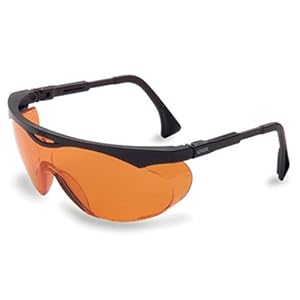
The treatment is a pair of blue-block glasses. Before you think of the 80s commercial about amber shades making the golf course look 'crystal clear,' let me share a little background:
 Melatonin is a substance produced naturally by the body to make you sleepy when it's dark. It is inhibited by light, particularly *blue* light, which is why people normally feel awake and alert during the day. Melatonin production can get disrupted in people with dysautonomia, fibromyalgia, CFS/ME, night-shift workers, nursing mothers, and people with sleep disorders. For some reason, the eyes don't respond to darkness cues properly or are exposed to excessive bright light at night, leaving us feeling revved up when the rest of the world is gearing down and exhausted when we should be refreshed.
What blue-block glasses do is protect the eyes from perceiving blue light. Worn only for a couple hours before bed, these glasses allow the body to produce more melatonin naturally, even in well-lit areas. I can wear them while watching TV, reading, using the computer, and all the while, my body is essentially fooled into thinking I am in total darkness. Not to be confused with regular sunglasses (which I tried and don't work!), these lenses are specifically designed filters that block out virtually all blue light involved in disrupting melatonin.
The effect has been remarkable for me. When it's time to fall asleep, I can drift off naturally and wake up at approximately the same time. No more drastically shifting bedtimes or widely varying wake times.
Additionally, I discovered the benefit of using blue-block light bulbs in the bedroom. These bulbs (which produce a pleasant yellow glow) can be used in place of the blue-block glasses in an otherwise dark room. Candlelight has been said to work too. The site I linked to also offers computer and TV blue-light filters as well as night-lights. The home page (lowbluelights.com) offers help on why and how to use these products most effectively.
From my experience, blue-block glasses at night are a great way to naturally wind down before bedtime without drugs or supplements. They help me to feel relaxed. Though not the cure for all sleep problems, they are well worth the effort if nothing else has worked for you or if you are seeking a drug-free way to improve your bedtime.
A few last words:
1. Be sure to read over basic "sleep hygiene" practices to use with the glasses for a better night's rest.
2. The Uvex brand (first link) is made with adjustable earpieces, which are not immediately obvious unless you know to push them in.
3. The LowBlueLights brand offer small sizes which are better for children and petite adults.
4. The glasses are not what I would call stylish, but if you are desperate for an earlier, regular bedtime without depending on pills, these might be worth a try.
They have certainly made a difference for me.
I am writing this post at 2:20 AM.
Why, you may ask, am I qualified to give advice on improving sleep?
For the past 5-1/2 years I was unable to fall asleep at the same time for more than a couple days in a row. Always shifting forward, some weeks I couldn't fall asleep till 6AM, and the next week 10AM, and the week after 2PM, and so forth. However, as of early this year, I can now maintain a regular bedtime indefinitely. What changed?
Achieving quality sleep at the right time has always been a battle for me. I have mild sleep apnea and a circadian rhythm disorder: Non-24 Hour Sleep-Wake Syndrome (think severe, advancing, chronic jet-lag). Improving my dysautonomia symptoms was difficult when I couldn't even get a regular night of sleep. Despite countless attempts to improve the situation, I've slept away many days and weeks in total frustration, missing important events, only to feel sicker, defeated, and out of options. But this year, I've finally discovered a safe and medication-free way to help me sleep on a regular schedule.
Call now for this special offer and get the bonus gift free! Just kidding.
No, this isn't an infomercial, and what I'm going to share isn't a miracle cure, but it has improved my quality of life and stopped my sleep from cycling around the clock every month. Best of all - no pills!
The treatment is a pair of blue-block glasses. Before you think of the 80s commercial about amber shades making the golf course look 'crystal clear,' let me share a little background:
 Melatonin is a substance produced naturally by the body to make you sleepy when it's dark. It is inhibited by light, particularly *blue* light, which is why people normally feel awake and alert during the day. Melatonin production can get disrupted in people with dysautonomia, fibromyalgia, CFS/ME, night-shift workers, nursing mothers, and people with sleep disorders. For some reason, the eyes don't respond to darkness cues properly or are exposed to excessive bright light at night, leaving us feeling revved up when the rest of the world is gearing down and exhausted when we should be refreshed.
What blue-block glasses do is protect the eyes from perceiving blue light. Worn only for a couple hours before bed, these glasses allow the body to produce more melatonin naturally, even in well-lit areas. I can wear them while watching TV, reading, using the computer, and all the while, my body is essentially fooled into thinking I am in total darkness. Not to be confused with regular sunglasses (which I tried and don't work!), these lenses are specifically designed filters that block out virtually all blue light involved in disrupting melatonin.
The effect has been remarkable for me. When it's time to fall asleep, I can drift off naturally and wake up at approximately the same time. No more drastically shifting bedtimes or widely varying wake times.
Additionally, I discovered the benefit of using blue-block light bulbs in the bedroom. These bulbs (which produce a pleasant yellow glow) can be used in place of the blue-block glasses in an otherwise dark room. Candlelight has been said to work too. The site I linked to also offers computer and TV blue-light filters as well as night-lights. The home page (lowbluelights.com) offers help on why and how to use these products most effectively.
From my experience, blue-block glasses at night are a great way to naturally wind down before bedtime without drugs or supplements. They help me to feel relaxed. Though not the cure for all sleep problems, they are well worth the effort if nothing else has worked for you or if you are seeking a drug-free way to improve your bedtime.
A few last words:
1. Be sure to read over basic "sleep hygiene" practices to use with the glasses for a better night's rest.
2. The Uvex brand (first link) is made with adjustable earpieces, which are not immediately obvious unless you know to push them in.
3. The LowBlueLights brand offer small sizes which are better for children and petite adults.
4. The glasses are not what I would call stylish, but if you are desperate for an earlier, regular bedtime without depending on pills, these might be worth a try.
They have certainly made a difference for me.
Tuesday, March 29, 2011
Exhausted
 When's the last time you said, "I'm exhausted!"?
Did you say it at the end of a long, satisfying day of work?
Or was it barely a whisper off your lips while you were lying helplessly in bed for hours?
Exhaustion, to me, used to mean that I'd crammed too many classes, experiments, meetings, and social events into a day.
Now, it is a mind/body/emotional bankruptcy from sickness and prolonged trial. A feeling of utter weariness. It's as if I'm one of those vacuum sealed bags on an infomercial; someone inserts the attachment and sucks out every last ounce of air until I shrivel up.
Last week, I watched a Bible study video on exhaustion. As I dragged myself into the room and opened my notebook, I looked forward to finding help with this familiar problem. I was disappointed to hear tips about taking a quiet retreat, accepting assistance, and dispensing with unnecessary commitments. Sadly, none of these tips help someone who can't escape their burdens, is minimally committed, and whose proper sources of assistance have either turned away or dried up.
The final point of the video? A long story about how God had made supernatural provision for an old man to have his tangled hair brushed before meeting his wife again.
I was supposed to feel encouraged, but I left feeling even emptier than when I came in. If God cares for the hair of an old man, why is my family spending years in circumstances that are draining the life out of us? Where is God when I feel exhausted and in pain?
I have been struggling to keep faith in the midst of one trial on top of another, on top of another. I look to heaven for help, and often I just get enough to survive another day of difficulty. Another day, another struggle.
I keep thinking, what is it God wants to show me about exhaustion?
I think the most important thing to know about exhaustion is that it is a breeding ground for temptation. Temptation to doubt God. Temptation to give up. Temptation to justify disobedience. Temptation to pull away from faith and contrive inadequate human solutions instead.
When Satan had taken everything Job had, including his children, the Enemy was convinced that the destruction of Job's health would finally break him.
“Skin for skin!” Satan replied. “A man will give all he has for his own life. But stretch out your hand and strike his flesh and bones, and he will surely curse you to your face.”
We need to remember that when we become physically sick and tired, it can be the Enemy's ultimate weapon to break us. However, Job was determined to cling to God, never giving in to the temptation to curse God and die. Instead, he proclaimed his faith boldly in the midst of his utter physical misery Job 19:25-27.
When David was forced to give up his throne and flee from his own son, his trusted adviser betrayed him in his weakest hour by planning the perfect attack.
"I will come upon him while he is weary and discouraged and throw him into a panic, and all the people who are with him will flee."
If you're exhausted, it's a pivotal time to be on guard. Dr. Charles Stanley, in his sermon series on temptation, reminds us that Satan attacks hardest when we are (HALT) Hungry, Angry, Lonely, and Tired. Preparing for the temptations with scripture means we won't be blindsided. We also need to prepare for feelings of fear and isolation. The withdrawal of human support often accompanies intense spiritual attack. We counter that by seeking God's support in prayer.
While David fled, a relative of his old enemy taunted him, cursed him, and physically threw rocks at David along the way.
"Get out, get out, you man of blood, you worthless man!"
This is a taunt, strong rejection, and an accusation all in one. It tore at David's very character and self-image. These words resonate with me because in my grandma's demented state, she can say things like this almost verbatim. ("Get out, get out, you awful woman!") Sitting under a waterfall of nonstop criticism and personal insults is emotionally draining to say the least. Though the accusations aren't true, they still erode my strength.
Satan's name literally means "the accuser," and he specializes in tormenting people with false guilt and condemnation. He knows that as long as we are neutralized by feeling bad about ourselves, we won't be powerful in spreading the gospel, encouragement, or hope in the lives of others. We counter this by rejecting wrong thoughts and memorizing scripture that reveals how God views us.
To summarize, scripture clearly outlines the Enemy's exhaustion attack plan:
1. Physical illness to break us
2. Temptation striking at our weakest moments
3. Isolation and Fear
4. Personal insults/Criticism
5. Rejection
6. False guilt for non-sins/Condemnation for forgiven sins
Knowing the Enemy's attack plan can help us withstand the onslaught and not become victims of permanent despair. Instead of giving up, I can:
A) Determine to cling to God
B) Seek God's support in prayer
C) Memorize/pray these truths from God's word
My soul is weary with sorrow; strengthen me according to your word.
Psalm 119:28
Consider him [Jesus] who endured such opposition from sinful men, so that you will not grow weary and lose heart.
Hebrews 12:2-3
“Never will I leave you;
never will I forsake you.”
So we say with confidence, “The Lord is my helper; I will not be afraid. What can man do to me?”
Hebrews 13:5-6
"My sheep listen to my voice; I know them, and they follow me. I give them eternal life, and they shall never perish; no one can snatch them out of my hand."
John 10:27-28
The LORD is the everlasting God, the Creator of the ends of the earth.
He will not grow tired or weary, and his understanding no one can fathom.
He gives strength to the weary and increases the power of the weak.
Isaiah 40:28-29
Though I may not have control over my health or circumstances, I have control over my response to the weight of exhaustion. Like Job, I must cling to my Redeemer no matter the cost. By trusting in his death for my sins, I am destined for a better land where "moth and rust do not destroy, where thieves do not break in and steal," where there is "no more death or mourning or crying or pain."
Determine to persevere through exhaustion on your journey with Christ. The Lord is with you and will reward you for your faith.
Subscribe to:
Posts (Atom)
