I was able to attend a college orchestra concert tonight. After all the performers were in place and the stage was set, the audience became quiet as we waited for the music to begin.
There was only one problem. The conductor didn't come out.
At first, I thought the few seconds of delay might be for dramatic effect, but time ticked by. Someone coughed loudly. People were looking around, shuffling in seats. Someone coughed again. Soft murmurs and low speculative chatter. The percussionists appeared to go backstage to look. I thought, "This isn't planned. Something isn't right." My friend and I exchanged glances.
Everyone waited for what seemed like 5 minutes but was probably closer to 2. Finally, the conductor emerged and quickly took her post in front of the group with her hands poised to conduct the first note. Not a word was spoken about the strange delay.
I wondered where she had been. Why had she, a respected professional, offered no explanation? What could have caused her to delay her group from beginning on time? What more than an emergency could have held her back?
Later, after the concert was over, it was revealed that she had been ready all along. The delay was because one of the orchestra members did not have a mute and could not perform any of the pieces without it. Until the mute was retrieved, the concert couldn't start.
To everyone in the audience, the conductor appeared to be at fault. However, she had mercifully covered for an unprepared member of the group.
On the way home, I started thinking about how I perceive delays in my own circumstances. My go-to person to confront and blame is God. He's the leader after all, and if he was ready to come out and make things right in this world (and in my life), then there should be no hold up. What, after all, could keep him from acting immediately when the stage appears to be set for his intervention and deliverance?
When I think this way, I fail to consider that God considers us all players in this world with him, and though he leads us, he will not force us all to be prepared for his coming. He mercifully waits, hoping that more people will come to faith in Jesus, that those of us who believe will forsake our earthly idols and begin to love him with all our hearts.
When he comes back, will you be prepared? Will you be longing for his appearing? Or are you sitting back, resting and backsliding because you think he's running late (or might never come at all)?
Be assured, the Messiah will return to earth suddenly and without warning. We are promised in scripture that we will be rewarded if we live spiritually prepared and ready for that day. In the meantime, it does me good to remember that sometimes God's delays are merciful, allowing just enough time for all the players in my life to become prepared - especially me.
I think about the valuable lessons God continues to teach me through my season of waiting, and although I want the circumstances removed right away, he uses them as tools to prepare me, to reshape me, to purify me. Tonight's experience at the concert was a reminder that He will indeed come to redeem my trials for his glory - in his merciful time.
But do not forget this one thing, dear friends: With the Lord a day is like a thousand years, and a thousand years are like a day. The Lord is not slow in keeping his promise, as some understand slowness. He is patient with you, not wanting anyone to perish, but everyone to come to repentance.
2 Peter 3:8-9
Tuesday, April 19, 2011

Thursday, April 7, 2011
Living Better with Dysautonomia (Help #6: Sleep)
Help #6: Regular Sleep
I am writing this post at 2:20 AM.
Why, you may ask, am I qualified to give advice on improving sleep?
For the past 5-1/2 years I was unable to fall asleep at the same time for more than a couple days in a row. Always shifting forward, some weeks I couldn't fall asleep till 6AM, and the next week 10AM, and the week after 2PM, and so forth. However, as of early this year, I can now maintain a regular bedtime indefinitely. What changed?
Achieving quality sleep at the right time has always been a battle for me. I have mild sleep apnea and a circadian rhythm disorder: Non-24 Hour Sleep-Wake Syndrome (think severe, advancing, chronic jet-lag). Improving my dysautonomia symptoms was difficult when I couldn't even get a regular night of sleep. Despite countless attempts to improve the situation, I've slept away many days and weeks in total frustration, missing important events, only to feel sicker, defeated, and out of options. But this year, I've finally discovered a safe and medication-free way to help me sleep on a regular schedule.
Call now for this special offer and get the bonus gift free! Just kidding.
No, this isn't an infomercial, and what I'm going to share isn't a miracle cure, but it has improved my quality of life and stopped my sleep from cycling around the clock every month. Best of all - no pills!
The treatment is a pair of blue-block glasses. Before you think of the 80s commercial about amber shades making the golf course look 'crystal clear,' let me share a little background:
 Melatonin is a substance produced naturally by the body to make you sleepy when it's dark. It is inhibited by light, particularly *blue* light, which is why people normally feel awake and alert during the day. Melatonin production can get disrupted in people with dysautonomia, fibromyalgia, CFS/ME, night-shift workers, nursing mothers, and people with sleep disorders. For some reason, the eyes don't respond to darkness cues properly or are exposed to excessive bright light at night, leaving us feeling revved up when the rest of the world is gearing down and exhausted when we should be refreshed.
What blue-block glasses do is protect the eyes from perceiving blue light. Worn only for a couple hours before bed, these glasses allow the body to produce more melatonin naturally, even in well-lit areas. I can wear them while watching TV, reading, using the computer, and all the while, my body is essentially fooled into thinking I am in total darkness. Not to be confused with regular sunglasses (which I tried and don't work!), these lenses are specifically designed filters that block out virtually all blue light involved in disrupting melatonin.
The effect has been remarkable for me. When it's time to fall asleep, I can drift off naturally and wake up at approximately the same time. No more drastically shifting bedtimes or widely varying wake times.
Additionally, I discovered the benefit of using blue-block light bulbs in the bedroom. These bulbs (which produce a pleasant yellow glow) can be used in place of the blue-block glasses in an otherwise dark room. Candlelight has been said to work too. The site I linked to also offers computer and TV blue-light filters as well as night-lights. The home page (lowbluelights.com) offers help on why and how to use these products most effectively.
From my experience, blue-block glasses at night are a great way to naturally wind down before bedtime without drugs or supplements. They help me to feel relaxed. Though not the cure for all sleep problems, they are well worth the effort if nothing else has worked for you or if you are seeking a drug-free way to improve your bedtime.
A few last words:
1. Be sure to read over basic "sleep hygiene" practices to use with the glasses for a better night's rest.
2. The Uvex brand (first link) is made with adjustable earpieces, which are not immediately obvious unless you know to push them in.
3. The LowBlueLights brand offer small sizes which are better for children and petite adults.
4. The glasses are not what I would call stylish, but if you are desperate for an earlier, regular bedtime without depending on pills, these might be worth a try.
They have certainly made a difference for me.
I am writing this post at 2:20 AM.
Why, you may ask, am I qualified to give advice on improving sleep?
For the past 5-1/2 years I was unable to fall asleep at the same time for more than a couple days in a row. Always shifting forward, some weeks I couldn't fall asleep till 6AM, and the next week 10AM, and the week after 2PM, and so forth. However, as of early this year, I can now maintain a regular bedtime indefinitely. What changed?
Achieving quality sleep at the right time has always been a battle for me. I have mild sleep apnea and a circadian rhythm disorder: Non-24 Hour Sleep-Wake Syndrome (think severe, advancing, chronic jet-lag). Improving my dysautonomia symptoms was difficult when I couldn't even get a regular night of sleep. Despite countless attempts to improve the situation, I've slept away many days and weeks in total frustration, missing important events, only to feel sicker, defeated, and out of options. But this year, I've finally discovered a safe and medication-free way to help me sleep on a regular schedule.
Call now for this special offer and get the bonus gift free! Just kidding.
No, this isn't an infomercial, and what I'm going to share isn't a miracle cure, but it has improved my quality of life and stopped my sleep from cycling around the clock every month. Best of all - no pills!
The treatment is a pair of blue-block glasses. Before you think of the 80s commercial about amber shades making the golf course look 'crystal clear,' let me share a little background:
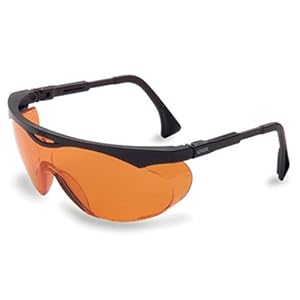 Melatonin is a substance produced naturally by the body to make you sleepy when it's dark. It is inhibited by light, particularly *blue* light, which is why people normally feel awake and alert during the day. Melatonin production can get disrupted in people with dysautonomia, fibromyalgia, CFS/ME, night-shift workers, nursing mothers, and people with sleep disorders. For some reason, the eyes don't respond to darkness cues properly or are exposed to excessive bright light at night, leaving us feeling revved up when the rest of the world is gearing down and exhausted when we should be refreshed.
What blue-block glasses do is protect the eyes from perceiving blue light. Worn only for a couple hours before bed, these glasses allow the body to produce more melatonin naturally, even in well-lit areas. I can wear them while watching TV, reading, using the computer, and all the while, my body is essentially fooled into thinking I am in total darkness. Not to be confused with regular sunglasses (which I tried and don't work!), these lenses are specifically designed filters that block out virtually all blue light involved in disrupting melatonin.
The effect has been remarkable for me. When it's time to fall asleep, I can drift off naturally and wake up at approximately the same time. No more drastically shifting bedtimes or widely varying wake times.
Additionally, I discovered the benefit of using blue-block light bulbs in the bedroom. These bulbs (which produce a pleasant yellow glow) can be used in place of the blue-block glasses in an otherwise dark room. Candlelight has been said to work too. The site I linked to also offers computer and TV blue-light filters as well as night-lights. The home page (lowbluelights.com) offers help on why and how to use these products most effectively.
From my experience, blue-block glasses at night are a great way to naturally wind down before bedtime without drugs or supplements. They help me to feel relaxed. Though not the cure for all sleep problems, they are well worth the effort if nothing else has worked for you or if you are seeking a drug-free way to improve your bedtime.
A few last words:
1. Be sure to read over basic "sleep hygiene" practices to use with the glasses for a better night's rest.
2. The Uvex brand (first link) is made with adjustable earpieces, which are not immediately obvious unless you know to push them in.
3. The LowBlueLights brand offer small sizes which are better for children and petite adults.
4. The glasses are not what I would call stylish, but if you are desperate for an earlier, regular bedtime without depending on pills, these might be worth a try.
They have certainly made a difference for me.
Tuesday, March 29, 2011
Exhausted
 When's the last time you said, "I'm exhausted!"?
Did you say it at the end of a long, satisfying day of work?
Or was it barely a whisper off your lips while you were lying helplessly in bed for hours?
Exhaustion, to me, used to mean that I'd crammed too many classes, experiments, meetings, and social events into a day.
Now, it is a mind/body/emotional bankruptcy from sickness and prolonged trial. A feeling of utter weariness. It's as if I'm one of those vacuum sealed bags on an infomercial; someone inserts the attachment and sucks out every last ounce of air until I shrivel up.
Last week, I watched a Bible study video on exhaustion. As I dragged myself into the room and opened my notebook, I looked forward to finding help with this familiar problem. I was disappointed to hear tips about taking a quiet retreat, accepting assistance, and dispensing with unnecessary commitments. Sadly, none of these tips help someone who can't escape their burdens, is minimally committed, and whose proper sources of assistance have either turned away or dried up.
The final point of the video? A long story about how God had made supernatural provision for an old man to have his tangled hair brushed before meeting his wife again.
I was supposed to feel encouraged, but I left feeling even emptier than when I came in. If God cares for the hair of an old man, why is my family spending years in circumstances that are draining the life out of us? Where is God when I feel exhausted and in pain?
I have been struggling to keep faith in the midst of one trial on top of another, on top of another. I look to heaven for help, and often I just get enough to survive another day of difficulty. Another day, another struggle.
I keep thinking, what is it God wants to show me about exhaustion?
I think the most important thing to know about exhaustion is that it is a breeding ground for temptation. Temptation to doubt God. Temptation to give up. Temptation to justify disobedience. Temptation to pull away from faith and contrive inadequate human solutions instead.
When Satan had taken everything Job had, including his children, the Enemy was convinced that the destruction of Job's health would finally break him.
“Skin for skin!” Satan replied. “A man will give all he has for his own life. But stretch out your hand and strike his flesh and bones, and he will surely curse you to your face.”
We need to remember that when we become physically sick and tired, it can be the Enemy's ultimate weapon to break us. However, Job was determined to cling to God, never giving in to the temptation to curse God and die. Instead, he proclaimed his faith boldly in the midst of his utter physical misery Job 19:25-27.
When David was forced to give up his throne and flee from his own son, his trusted adviser betrayed him in his weakest hour by planning the perfect attack.
"I will come upon him while he is weary and discouraged and throw him into a panic, and all the people who are with him will flee."
If you're exhausted, it's a pivotal time to be on guard. Dr. Charles Stanley, in his sermon series on temptation, reminds us that Satan attacks hardest when we are (HALT) Hungry, Angry, Lonely, and Tired. Preparing for the temptations with scripture means we won't be blindsided. We also need to prepare for feelings of fear and isolation. The withdrawal of human support often accompanies intense spiritual attack. We counter that by seeking God's support in prayer.
While David fled, a relative of his old enemy taunted him, cursed him, and physically threw rocks at David along the way.
"Get out, get out, you man of blood, you worthless man!"
This is a taunt, strong rejection, and an accusation all in one. It tore at David's very character and self-image. These words resonate with me because in my grandma's demented state, she can say things like this almost verbatim. ("Get out, get out, you awful woman!") Sitting under a waterfall of nonstop criticism and personal insults is emotionally draining to say the least. Though the accusations aren't true, they still erode my strength.
Satan's name literally means "the accuser," and he specializes in tormenting people with false guilt and condemnation. He knows that as long as we are neutralized by feeling bad about ourselves, we won't be powerful in spreading the gospel, encouragement, or hope in the lives of others. We counter this by rejecting wrong thoughts and memorizing scripture that reveals how God views us.
To summarize, scripture clearly outlines the Enemy's exhaustion attack plan:
1. Physical illness to break us
2. Temptation striking at our weakest moments
3. Isolation and Fear
4. Personal insults/Criticism
5. Rejection
6. False guilt for non-sins/Condemnation for forgiven sins
Knowing the Enemy's attack plan can help us withstand the onslaught and not become victims of permanent despair. Instead of giving up, I can:
A) Determine to cling to God
B) Seek God's support in prayer
C) Memorize/pray these truths from God's word
My soul is weary with sorrow; strengthen me according to your word.
Psalm 119:28
Consider him [Jesus] who endured such opposition from sinful men, so that you will not grow weary and lose heart.
Hebrews 12:2-3
“Never will I leave you;
never will I forsake you.”
So we say with confidence, “The Lord is my helper; I will not be afraid. What can man do to me?”
Hebrews 13:5-6
"My sheep listen to my voice; I know them, and they follow me. I give them eternal life, and they shall never perish; no one can snatch them out of my hand."
John 10:27-28
The LORD is the everlasting God, the Creator of the ends of the earth.
He will not grow tired or weary, and his understanding no one can fathom.
He gives strength to the weary and increases the power of the weak.
Isaiah 40:28-29
Though I may not have control over my health or circumstances, I have control over my response to the weight of exhaustion. Like Job, I must cling to my Redeemer no matter the cost. By trusting in his death for my sins, I am destined for a better land where "moth and rust do not destroy, where thieves do not break in and steal," where there is "no more death or mourning or crying or pain."
Determine to persevere through exhaustion on your journey with Christ. The Lord is with you and will reward you for your faith.
Thursday, March 17, 2011
Living Better with Dysautonomia (Help #5: Diet)

Help #5: Anti-inflammatory Diet + Salt
I don't know about you, but symptom flares typically send me running for the nearest comfort food. Daily I used to consume desserts like dark chocolate, ice cream, cookies, and cupcakes. For snacks, I relied on quick fixes like a bowl of cereal, toast, PB&J, popcorn, pasta, or a glass of juice. I didn't have energy to make fancy meals.
These foods helped me to feel good in the moment, but in the long run, I suffered symptoms of hypoglycemia, uncomfortable digestive problems, muscle aches, and terrible fatigue.
Over the past year, I've been equipped with more knowledge about eating an anti-inflammatory diet. Determining to do this has made a noticeable difference in my symptoms, but it is only part of the puzzle. I still experiment with diet choices and other treatments to optimize my health.
First and foremost, I've learned to cut out all unnecessary sugar and white flour.
This may sound impossible, especially when it's such a comfort. I didn't think I'd make it more than one day (two, tops) without desserts or high-carb foods. I decided to try going cold turkey for as long as I could, and after a few days of resisting the intense cravings, it was suddenly easier to say no to sweets. I trained my taste buds to enjoy a sweet potato without brown sugar. I drank tea instead of juice in the morning. Eventually, I grew accustomed to living on a low-sugar diet and began to enjoy the natural sweetness of fruit, the richness of cocoa powder in milk, and the creaminess of plain yogurt. I don't mean to say that I deprive myself entirely of occasional treats, but now that I see the benefits for my health, I don't go straight for sugar when I'm hungry. Instead, I go for protein, which is my next tip...
Second, I make an effort to base meals and snacks around healthy protein sources.
Instead of grabbing for toast when I'm hungry, I now reach for salted almonds. Instead of cereal, I scramble an egg. Almond butter with banana has replaced ice cream with banana. My new rule to include protein (or slow-digesting carbs) in every snack keeps my blood sugar stable and lessens fatigue. I don't experience sudden cravings and lightheadedness between meals anymore. Eating protein regularly gives me a more steady sense of well-being with lasting fullness and satisfaction.
Third, I have added in more organic vegetables and salads to my diet.
Salad used to be the thing I'd put Saran wrap over at the end of a meal because I didn't have room for it. Now, it's become a main course. Salad isn't boring when you can put a lot of protein on it. Some of my favorite salad toppings include crispy chicken sauteed in olive oil, crumbled bacon, shredded cheese, sunflower seeds, shredded turkey, bits of salmon or tuna, diced tomato and cucumber, or even a Mexican twist with seasoned ground meat, fresh avocado, onion, and cilantro leaves. In addition to building tasty salads, I've also learned to enjoy steamed vegetables like carrots, green beans, broccoli, and asparagus. A little salt and heart-healthy margarine make these vegetables delicious, and as a bonus, I don't feel bloated or sick after I eat them.
Learning what foods pack the most nutritional punch has continued to be challenging but fun. The book Anticancer: A New Way of Life started me off in the right direction by pointing me toward a diet rich in nutritious foods instead of settling for carryout burritos and prepared frozen entrees. Pairing this knowledge with a focus on protein and vegetables, while cutting back on sugar and unhealthy carbohydrates, has improved my health even more.
Beware of food allergies and sensitivities!
Hidden food sensitivities can sometimes play a role in how a person with dysautonomia feels. Diagnosing a gluten, nut, wheat, soy, egg, or dairy sensitivity could be vital to aiding your recovery, so I urge you to speak to your doctor about testing and elimination diets. Not all food sensitivities express themselves as stomach upset. Fatigue, rashes, and vitamin deficiencies can all be signals of a food intolerance. *I did not test positive for celiac disease but still found significant symptom improvement from eating strictly gluten-free and mostly dairy-free.*
In the meantime, remember that every food you put in your mouth contains powerful vitamins and nutrients that can influence the amount of inflammation in your body, just like any medicine or pill. Steering clear of sugar, white flour, and unhealthy, high-carbohydrate snacks may help you feel more clear-headed and less fatigued.
What about salt?
If you suffer from low blood pressure (which is common with dysautonomia), it's likely that your doctor has encouraged you to start a high-salt diet. Do this ONLY under the recommendation of your physician because a high-salt diet will raise blood pressure and can be potentially dangerous.
Be aware: Salt and sodium are two different things.
High school chemistry returns to haunt us! Salt is NaCl; sodium is Na. Salt is made up of 39% sodium. I was so sick and disoriented at my diagnosis that I missed this altogether and panicked at the level of salt prescribed.
If a doctor tells you to eat 8 grams of salt per day, they do NOT mean that you should eat 8,000 mg of sodium. They mean you should eat 3,120 mg of sodium. That’s still a lot, but thankfully it does not involve you solely eating SPAM and salt tablets. The best way to get enough sodium in your diet is to be liberal with the salt shaker. Try to avoid sea salt since the large, coarse crystals give you less sodium per serving than regular table salt.
If you need a quick boost of sodium, try chicken noodle soup. My favorite (gluten-free/dairy-free) brand is Kettle Cuisine.
Bottom line: Better fuel = Better function. The more nutritious foods you can pack into your diet, the better your body will run. Reducing chronic inflammation through diet is a smart decision for anyone looking to improve energy and lower the risk of cancer.
Here are some of my new favorite simple and healthy snacks (*Updated 2/13/12*):
Numi Green Rooibos tea
Alvita Ginger Root tea
Microwaved sweet potato with cinnamon and pumpkin pie spices
Amande yogurt (almond yogurt: dairy-free/gluten-free/soy-free)
Walnuts, pecans, Blue Diamond Roasted Salted Almonds
Papaya smoothies with banana, pineapple, and lime juice
Redmond's Almond Butter with banana
Nuttzo (multi-nut butter, available in regular and peanut-free) on toast with a drop of cherry preserves
Scrambled egg with diced onion, diced bell pepper, and Rice Shreds cheese (also available for vegans)
Egg salad (egg, mustard, mayo) or tuna salad (tuna, onion, egg, mayo) on Udi's Whole Grain bread (gluten-free)
Salted hard-boiled egg
Baby carrots with or without hummus
Kind bars (coconut/apricot/almond)
Microwaved green beans or mixed veggies (as a substitute for chips) with an open-faced sandwich
Quinoa cooked in chicken broth with peas and pieces of roast chicken
Salmon baked in parchment paper with lemon, salt, pepper, and olive oil
Mashed avocado with minced garlic, cilantro, lemon juice, salt, chopped onion
Riceworks brown rice chips with rice cheese, salsa, or guacamole
Low-Carb Banana Nut Muffins
1.5 c almond flour
2 ripe, mashed bananas
1 tsp baking powder
1 tsp baking soda
3 eggs
1/2 c organic unsweetened applesauce
1/2 tsp cinnamon
1/8 tsp freshly grated nutmeg
1 tsp vanilla
1/4 tsp salt
1/2 c chopped walnuts or pecans
Bake at 350 for 20-25 minutes. (Heavily adapted from "Eating Stella Style")
If you have any healthy snack ideas to share, please post in the comments!
Tuesday, March 1, 2011
Courage in the Lonely Hour
Courage in the Lonely Hour
Dr. Charles Stanley gives powerful encouragement for those who are struggling.
Dr. Charles Stanley gives powerful encouragement for those who are struggling.
Sunday, February 27, 2011
Not Feelin' It
My grandma has lived with us since she had a stroke about three and a half years ago. Over that time, her ability to function has drastically declined; she has been diagnosed with more strokes as well as vascular dementia (similar to Alzheimer's).
This condition has completely altered her personality, compromised her ability to reason and think, and made her unable to deal with basic daily tasks such as the toilet and bathing. At this point, she requires 24-hour care and supervision so that she does not accidentally hurt herself or others.
Today I spent the afternoon and evening with her. She was having hallucinations the entire time, but she talked about them to me as if they were very real. Among other things, she saw a dog, a girl, a baby (behind her pillows), two mice in her bed, needles, water on the floor, threads, and her sister from out-of-state.
Every time she would reach for something that wasn't there or ask a question about an invisible visitor, I responded by telling her that these things weren't real. She knows that she has had a stroke, and so I explained over and over that she was having some trouble with seeing things that weren't there and that she was safe from mice and whatever else she was concerned about.
I thought this would calm her, but she continued unfazed, often telling me I was wrong. My words of comfort and reason meant nothing.
Grandma: Is it raining? (holding her hand up to feel for water)
Me: No, we're inside.
Grandma: Yes, I know, but do you feel rain?
Grandma: Is the little girl ok?
Me: There's no little girl. There's no one here.
Grandma: Yes, that's right, only you and me.
Me: Right.
Grandma: I think I should check on the little girl.
These conversations can become very sad and difficult because there is no communication happening. She refuses to believe that what she perceives could be faulty.
While I was watching her pursue investigations into people whom I assured her were not there, I was struck by the thought that it's human nature to trust what we see and feel over all else - even testimony of the truth.
In times of darkness, when I feel so alone and don't sense or see God moving, it's very easy to rely on my own perceptions as reality. I can often be overcome by the feeling that there is no end to our trials, that no one will ever understand, even that God doesn't care. And I can start to lean into that, even in the face of scripture that refutes me entirely. How many of us trust our own feelings and experiences over what we read in the Bible?
If I think about my experiences with my grandma, I can recall the many times I've lovingly tried to calm and correct her by exposing the deception of her hallucinations and revealing to her the truth of reality. I have been rejected repeatedly as she persists in trusting her feelings over my testimony of the facts.
It is convicting to me that during times of darkness when I read God's Word, I must trust in what it says above all else and not let my heart or my eyes lead me astray. The world is full of deceptive messages, false claims, hollow philosophies, and circumstances that are confusing. My heart is full of wrong ideas, flawed logic, misguided justifications, and the insidious influences of human sin. The only way to get through this dark time is to trust the light of the only pure truth there is in this world, the Bible.
When I look to the Bible, I see example after example of people in dark and hopeless trials - Abraham who had no child, Joseph who was sold into slavery by his brothers and landed in prison for a crime he didn't commit , Esther who risked her life to approach the king and save her people from mass murder, Ruth who lost her husband and followed her mother-in-law in poverty, Job who lost it all but refused to curse God, Shadrach, Meshach, and Abednego who were about to be burned alive for their faith but held firm...

These people all had no reason to feel hopeful, but against all hope they believed God and were not put to shame. It is to our great advantage in the darkness not to trust our own flawed sense of reality to guide our choices. Doing that is like relying on a broken compass in order to get us to our destination. Instead, we must trust in the Word of God above all else, like a lighthouse that is shining our way safely home.
"Then you will know that I am the LORD; those who wait for me shall not be put to shame."
Isaiah 49:23
This condition has completely altered her personality, compromised her ability to reason and think, and made her unable to deal with basic daily tasks such as the toilet and bathing. At this point, she requires 24-hour care and supervision so that she does not accidentally hurt herself or others.
Today I spent the afternoon and evening with her. She was having hallucinations the entire time, but she talked about them to me as if they were very real. Among other things, she saw a dog, a girl, a baby (behind her pillows), two mice in her bed, needles, water on the floor, threads, and her sister from out-of-state.
Every time she would reach for something that wasn't there or ask a question about an invisible visitor, I responded by telling her that these things weren't real. She knows that she has had a stroke, and so I explained over and over that she was having some trouble with seeing things that weren't there and that she was safe from mice and whatever else she was concerned about.
I thought this would calm her, but she continued unfazed, often telling me I was wrong. My words of comfort and reason meant nothing.
Grandma: Is it raining? (holding her hand up to feel for water)
Me: No, we're inside.
Grandma: Yes, I know, but do you feel rain?
Grandma: Is the little girl ok?
Me: There's no little girl. There's no one here.
Grandma: Yes, that's right, only you and me.
Me: Right.
Grandma: I think I should check on the little girl.
These conversations can become very sad and difficult because there is no communication happening. She refuses to believe that what she perceives could be faulty.
While I was watching her pursue investigations into people whom I assured her were not there, I was struck by the thought that it's human nature to trust what we see and feel over all else - even testimony of the truth.
In times of darkness, when I feel so alone and don't sense or see God moving, it's very easy to rely on my own perceptions as reality. I can often be overcome by the feeling that there is no end to our trials, that no one will ever understand, even that God doesn't care. And I can start to lean into that, even in the face of scripture that refutes me entirely. How many of us trust our own feelings and experiences over what we read in the Bible?
If I think about my experiences with my grandma, I can recall the many times I've lovingly tried to calm and correct her by exposing the deception of her hallucinations and revealing to her the truth of reality. I have been rejected repeatedly as she persists in trusting her feelings over my testimony of the facts.
It is convicting to me that during times of darkness when I read God's Word, I must trust in what it says above all else and not let my heart or my eyes lead me astray. The world is full of deceptive messages, false claims, hollow philosophies, and circumstances that are confusing. My heart is full of wrong ideas, flawed logic, misguided justifications, and the insidious influences of human sin. The only way to get through this dark time is to trust the light of the only pure truth there is in this world, the Bible.
When I look to the Bible, I see example after example of people in dark and hopeless trials - Abraham who had no child, Joseph who was sold into slavery by his brothers and landed in prison for a crime he didn't commit , Esther who risked her life to approach the king and save her people from mass murder, Ruth who lost her husband and followed her mother-in-law in poverty, Job who lost it all but refused to curse God, Shadrach, Meshach, and Abednego who were about to be burned alive for their faith but held firm...
These people all had no reason to feel hopeful, but against all hope they believed God and were not put to shame. It is to our great advantage in the darkness not to trust our own flawed sense of reality to guide our choices. Doing that is like relying on a broken compass in order to get us to our destination. Instead, we must trust in the Word of God above all else, like a lighthouse that is shining our way safely home.
"Then you will know that I am the LORD; those who wait for me shall not be put to shame."
Isaiah 49:23
Thursday, February 24, 2011
Living Better with Dysautonomia (Help #4: Compression)
 Help #4: Compression Stockings
POTS affects blood flow. Because my body does not respond properly to gravity, blood that should be circulated into my head ends up pooled in my legs and abdomen when I am upright. This leaves me feeling lightheaded with a rapid heart rate and low blood pressure - perfect ingredients to feel faint and ill. When I put on compression hose, the stockings squeeze the vessels in my legs to keep blood from settling there. This increases my ability to stand and sit up and helps get more blood/oxygen where it's needed most - my head!
Never fear! You won't look (too) weird in these. :) When covered by pants and socks, they are hardly noticeable.
The best part about compression stockings is that they are constantly working. Unlike medication that has to be taken on time and can wear off, these stretchy socks remain tight and effective for as long as I need to be upright.
Summertime used to make me hesitate to use compression hose. For one thing, I wanted to wear sandals, and for another, I didn't want to feel too hot. But without compression, I found that my ability to stand with minimal symptoms was severely limited. Support stockings are worth the sacrifice to remain vertical. I have invested in lightweight crop pants and a cute pair of closed-toe summer flats that look just as nice as sandals; these enable me to wear my compression hose inconspicuously even in warm weather. Another alternative is to purchase open-toe stockings.
For special occasions like a party, I like to switch from the knee-high to the full-length hose. That extra support on my upper legs and abdomen is noticeable and helps me to remain more clear-headed when trying to keep up with conversation. I won't lie and say that the full-length are easy to put on, but once the wrestling is over, it's well worth the sacrifice to have that extra boost to my blood flow all day.
Now, the main questions I had when first buying compression hose are:
"what brand?"
"what strength?"
"where to buy?"
- My preferred brand is Jobst. (comfortable and hold up very well)
- My doctor recommended 15-20 mmHg strength for me. (could be different for you!)
- My preferred store is brightlifedirect.com.
BrightLife offers a variety of brands at different prices and allows you to try on and return stockings that don't fit. Through their site, I found athletic knee-high socks which are a nice change of pace from the pantyhose version. I was also able to try two brands of full-length stockings to determine which sheer style worked best for me.
Ideally, it's good to replace your stockings every 4 to 6 months (since they get stretched out), but I've found that with good care and rotation of multiple pairs, I can use them longer, understanding that my older socks aren't quite as effective as my newer ones.
Subscribe to:
Posts (Atom)
